Explainer · 5 min read
Did OpenAI solve Navier–Stokes?
On 8 September 2026 OpenAI said an AI system had resolved one of the Millennium Prize problems. Here is what it actually did, and what the solution looks like.
The short answer
The Clay Institute's Navier–Stokes prize lists four problems, A to D. The AI solved two of them, C and D. Problems A and B, the ones without an external force, are not solved.
See the four problems
| Option | What you would prove | External force | Space | Status |
|---|---|---|---|---|
| A | Smooth forever on all of spaceProve every smooth start stays smooth forever | No force | Whole space | Still open |
| B | Smooth forever in a periodic boxSame, in a box that repeats in every direction | No force | Periodic box | Still open |
| C | Breakdown on all of spaceFind one smooth start and one smooth push that break the equations | Smooth force allowed | Whole space | Proved by OpenAI |
| D | Breakdown in a periodic boxSame, in the repeating box | Smooth force allowed | Periodic box | Proved by OpenAI |
Why four? The question has two possible answers, smoothness always survives (A, B) or something breaks (C, D), and two playing fields, all of infinite space or a box that wraps around like a video-game map. Two times two. A proof of any one wins the prize.
The asymmetry that matters: in A and B the external force is zero, the fluid is on its own. In C and D a smooth force is allowed, as explicit "leeway" for solvers written by Charles Fefferman of Princeton in the official statement. OpenAI's system used that leeway. It says nothing about A and B.
What the problem asks
The Navier–Stokes equations are Newton's second law, force equals mass times acceleration, written for a fluid.
More on the equation
u is the velocity at every point, p the pressure, ν the viscosity, the fluid's internal friction, and f anything pushing from outside: gravity, a propeller, a stirring rod. The highlighted term is the only one where velocity multiplies itself, and it is where all the difficulty lives. In 2000 the Clay Mathematics Institute put a one-million-dollar prize on the question. Nobody had settled it in either direction for ninety years.
The question: can a smooth flow, following these equations, reach infinite speed in finite time? That is a singularity, and it would mean the equations stop describing a real fluid.
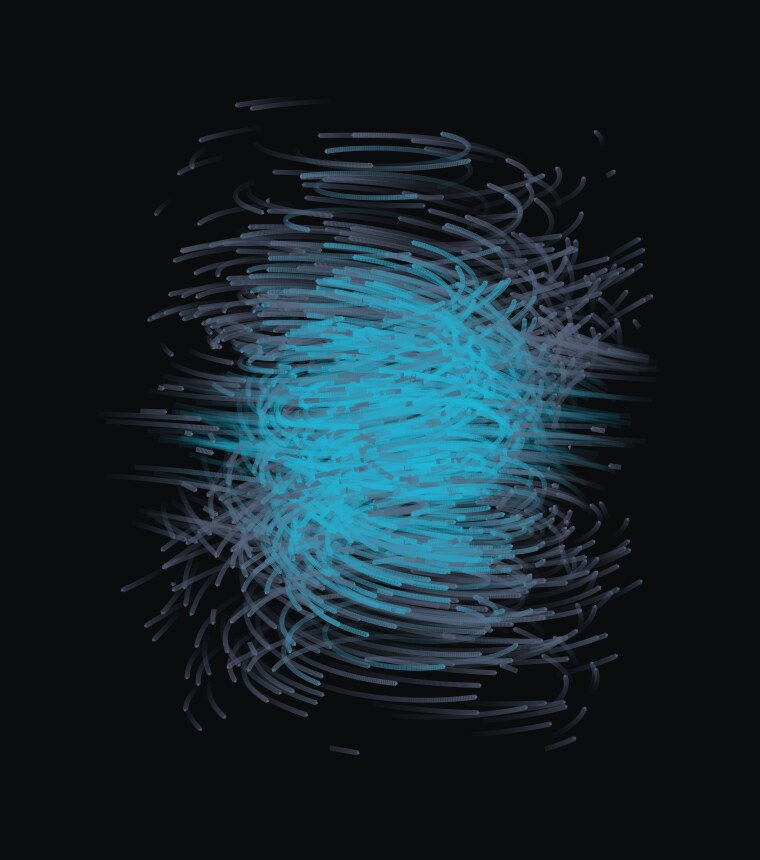
1. SmoothA gentle flow.
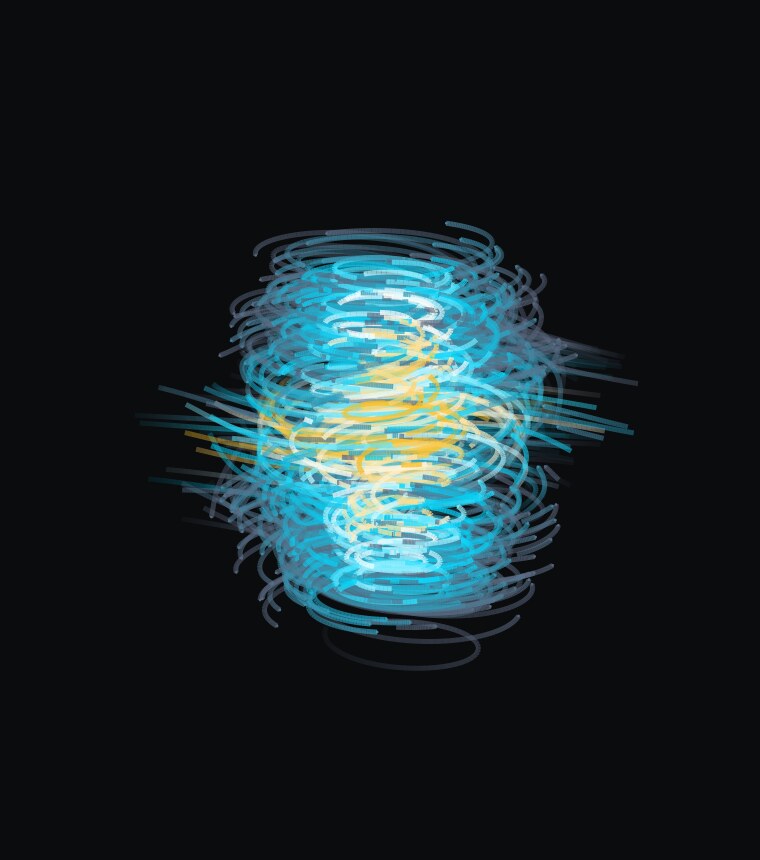
2. Starts to spinPulls inward, spins faster, the core shrinks.
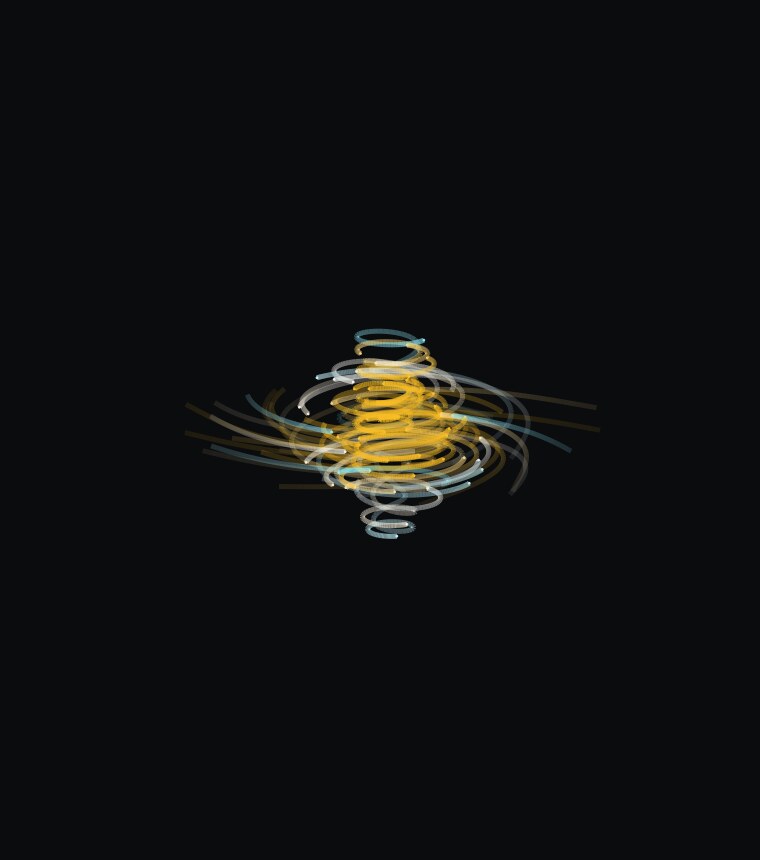
3. SingularitySpeed → ∞ in a shrinking point. The breakdown that C and D ask for.
With a push, a singularity happens. The AI built a flow that starts still and, with a smooth external force pushing it, reaches infinite speed in finite time. Without a push, nobody knows.
The solution, animated
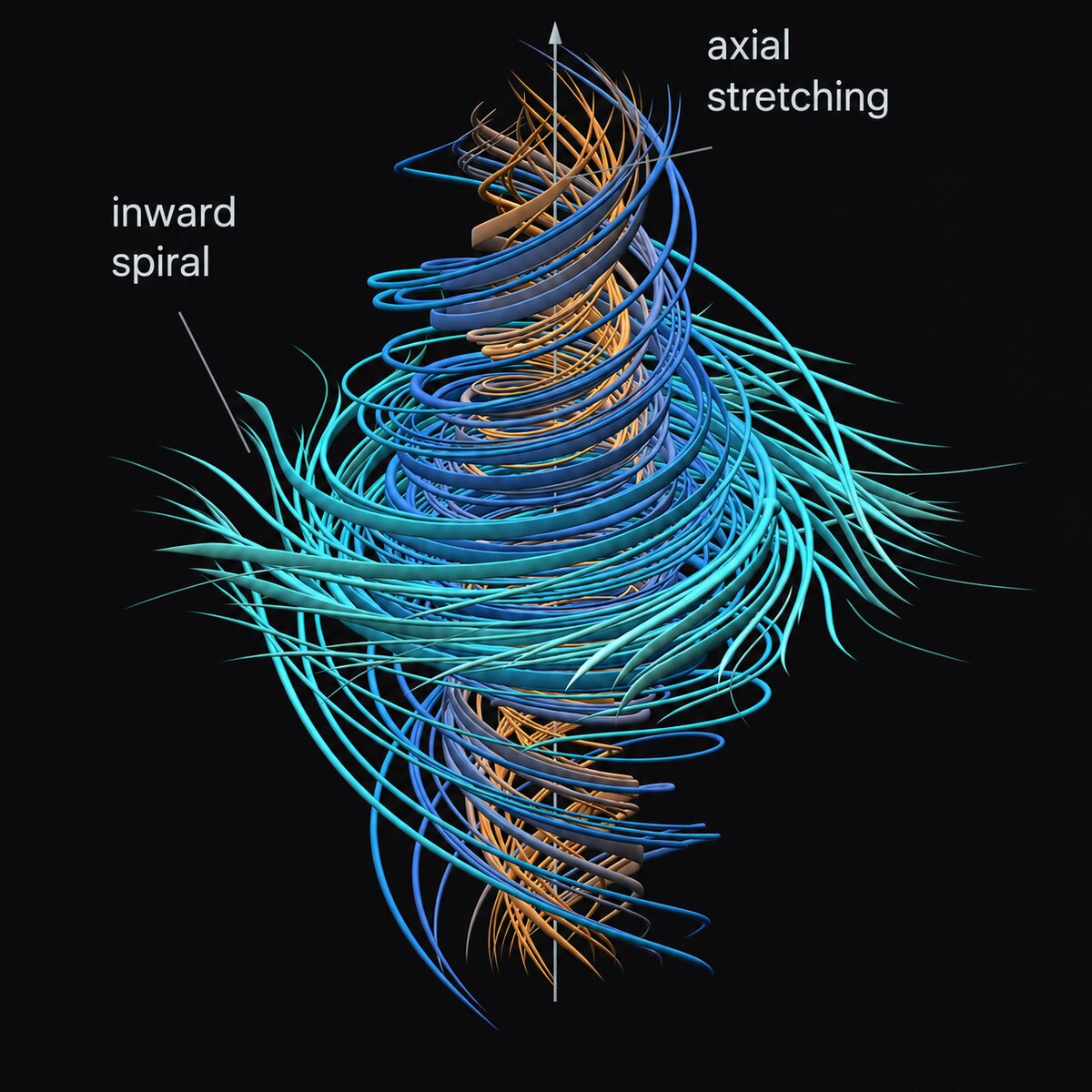
A single vortex. Fluid spirals inward toward an axis and squirts out along it. The core gets thinner faster than it gets shorter, so it stretches into a spinning filament whose speed climbs without limit while its energy shrinks to zero. Press start.
View properties
- time left τ
- 1.000
- core radius ~ τ½
- 1.000
- core height ~ τ½−h
- 1.000
- peak speed ~ τ−½−h
- 1.0×
- core energy ~ τ½−3h
- 100%
- zoom
- 1.0×
- tracers
- —
- stretch h
- 0.12 (paper: < 1/100)
Colour is speed relative to the current peak: grey slow, cyan fast, amber fastest. The speed cutoff hides tracers below that fraction of the peak, which is what isolates the vortex.
What this animation computes, and what it does not
Neither the paper nor this page runs a fluid simulation. The paper is an analytic proof: formulas and inequalities, checked by Lean. No solver could follow a singularity anyway, since the scales shrink to zero and the speeds grow without bound. The animation does something much simpler. It takes the shape of the solution the paper describes and moves tracer particles through it.
In cylindrical coordinates about the axis, with r the distance from the axis, z the height, τ the time left, and ℓr = √τ, ℓz = τ½−h the core's radius and height, the velocity field the animation uses is:
The scaling exponents are the paper's. The profile shapes E and U are the stand-ins: smooth bumps chosen so the swirl vanishes on the axis and fades with radius, and the outflow reverses across the dividing plane. In the paper those profiles are defined by the construction itself and have no formula. The tracer equation is an ordinary differential equation, integrated step by step; it is not the Navier–Stokes equation. So the picture is faithful to the structure and the scaling of the solution, and it is not a numerical solution of anything the paper proves.
What exactly was proved
- Any viscosity. Honey or air, the result holds. It is proved once for viscosity one and rescaled.
- All of 3D space, no walls. The fluid is unbounded. A periodic-box version covers option D.
- The fluid starts at rest. Zero velocity everywhere at time zero. All motion is created by the external force.
- The force is smooth and switches off. Infinitely differentiable, confined to a bounded region and a bounded window of time, smooth right through the breakdown. No infinite push anywhere.
- Energy stays finite. The total kinetic energy of the fluid is bounded throughout.
- Speed goes to infinity at time one. Everything is smooth before t = 1. At t = 1 the maximum speed is unbounded.
The core findings
The proof pins down how the vortex collapses. With τ the time left, running to zero, and h a small stretch parameter the paper keeps below 1/100:
| Quantity | Scaling | As τ → 0 | Why |
|---|---|---|---|
| Core radius | τ½ | → 0 | The viscous scale: shrink slower and friction stops mattering, faster and friction smooths it out. |
| Core height | τ½ − h | → 0, slower | A touch slower than the radius, so the core stretches into a filament. h is the one free knob. |
| Peak speed | τ−½ − h | → ∞ | Angular momentum carried inward: a skater pulling in their arms, without limit. |
| Core energy | τ½ − 3h | → 0 | Speed² × volume. Speed² grows like τ−1−2h, volume shrinks like τ3/2−h, and volume wins. |
These were not measured. The AI proposed them as the shape of the collapse, guided by the physics and by the 2023 Córdoba and Martínez-Zoroa constructions, then proved a flow with exactly these scalings exists and satisfies the equations with a smooth force. The proof is what makes them true.
What the proof actually is, in plain terms
It is a construction, not a derivation. To prove "a smooth flow can break" you only need one example, built in full and checked at every step. The AI built that example: the vortex above, with a force that makes the equations hold and a proof that the force stays gentle while the speed does not.
The proof, step by step
- Flip the problem. Normally you are given a force and must find the flow. Here you design the flow first, plug it into the equation, and call whatever is left over the force. The equation is then satisfied by definition. The whole challenge becomes: make that leftover smooth while the flow itself goes infinite.
- Design the flow. A vortex that collapses in a fixed shape: radius shrinking like √τ, height a touch slower, speed growing like 1/√τ and a bit more. Written in "similarity coordinates", where the collapse becomes a frozen picture and the profile is one fixed set of functions solved for once.
- Find the flaw. Plug that bare vortex in and the leftover force is infinite near the singular moment. Useless: an infinite push is cheating.
- Let the fluid push itself. Add rings of small, fast oscillations around the core. Each ring is seeded by an exponentially tiny nudge, grows by feeding on the vortex's shear, then is killed by viscosity. Its back-and-forth motion averages to zero, but the average of its momentum transport does not, the way waves with no net water flow still push sand up a beach. Two families of rings are tuned so that this steady push exactly cancels the infinite part of the leftover.
- Fix the fix, forever. That cancellation leaves a smaller error. Add a correction that kills it, which leaves a smaller error still. Each pass shrinks the error by a fixed power of the collapse scale. Infinitely many passes, summed, leave a leftover that is smooth right through the singular moment. Proving that every one of those sums converges, for every derivative, is where most of the 166 pages go.
- Calm the outside. Beyond the rings, the fluid just rotates and slowly spreads by friction, which solves the equations exactly with no force. That lets the violent core be cut off smoothly at a finite distance, so the fluid has finite energy and the force acts in a bounded region for a bounded time, switching the flow on from rest.
- Tick the boxes. Smooth start, smooth force, finite energy, whole space, any viscosity, speed unbounded at t = 1. That is option C word for word. Drop the same construction into a periodic box and it is option D.
- Have a machine check it. The argument was translated into Lean, a language in which every step must be justified from earlier steps or the checker refuses. It compiled. The code is public. What Lean cannot check is that the formal statement means what the paper says it means; that part is still on humans.
A useful mental picture: to prove "bridges of this design can fail", you do not need a theory of all bridges. You build one, load it until it fails, and document every weld. That is this proof. To prove "no bridge of this design can ever fail" you would need the theory, and that is options A and B, still open.
Why the big question is still open
What was proved
"There exists one specific push, applied to a fluid at rest, that makes it blow up."
What people want to know
"A fluid with no push at all, from any smooth start, never blows up." Or: "some unpushed start does."
The first does not settle the second in either direction. Option A is exactly as open today as it was before.
The honest reading
By the letter of the prize the problem is resolved, and OpenAI says it will not claim the money; Clay's rules need journal publication and two years of scrutiny anyway. The physically loaded question, can real turbulence in a real unforced fluid tear the continuum apart, is untouched. It also says nothing about the flows engineers simulate, where nobody is shaping the force to cause trouble. Charles Fefferman, who wrote the problem, told Quanta the heroes of the story are Diego Córdoba and Luis Martínez-Zoroa in Madrid, whose 2023 forced-Euler construction is the engine this proof runs on.
What it cost
Put those numbers in human terms
A token is about three quarters of a word, so 130 billion tokens is close to 100 billion words written by the agents to each other, roughly twenty times the whole of English Wikipedia, in under four days, to reach one paper. Across every problem attempted the figure is 300 billion tokens and 4.9 million messages. OpenAI gave no dollar figure; Sébastien Bubeck told Quanta the compute cost was "several million dollars". That excludes training the model, which is the real expense and is not disclosed.
How the AI did it
A swarm rather than one model: about ten thousand agents on an unreleased model, split into groups that attacked all four options at once, with the proof machine-checked in Lean afterwards.
The process, step by step
- An unreleased model, "significantly more capable than GPT‑6 Astra", in training since 28 August and upgraded mid-run.
- Agents in groups, each able to read a cached internet and run code. Some groups were told to prove A and B, others to disprove them via C and D.
- Easier problems first. About 100 agents cracked the viscosity-free Euler version in roughly 50 hours. That became the signal to pull everything onto Navier–Stokes.
- Cross-pollination. Codex periodically read every group's intermediate results and fed the useful ideas back as new prompts.
- Machine check. GPT‑6 Astra translated the proof into Lean in 17 hours. Humans still have to confirm the Lean statement means what the paper claims.
The dispute
Tristan Buckmaster of NYU, who with Levent Alpöge had been attacking the same problem with Anthropic's models and OpenAI's Codex, asked publicly whether his unpublished Codex sessions could have leaked into OpenAI's system. OpenAI says it investigated and found no path, including through training, and notes the two Euler proofs differ. Terence Tao's wider worry was that indiscriminate AI use risks turning mathematics into "a meaningless production quota game".